Major Gulf Coast Pipeline Expansions in 2025: A Strategic Opportunity for Data Centers and Industrial Energy Users
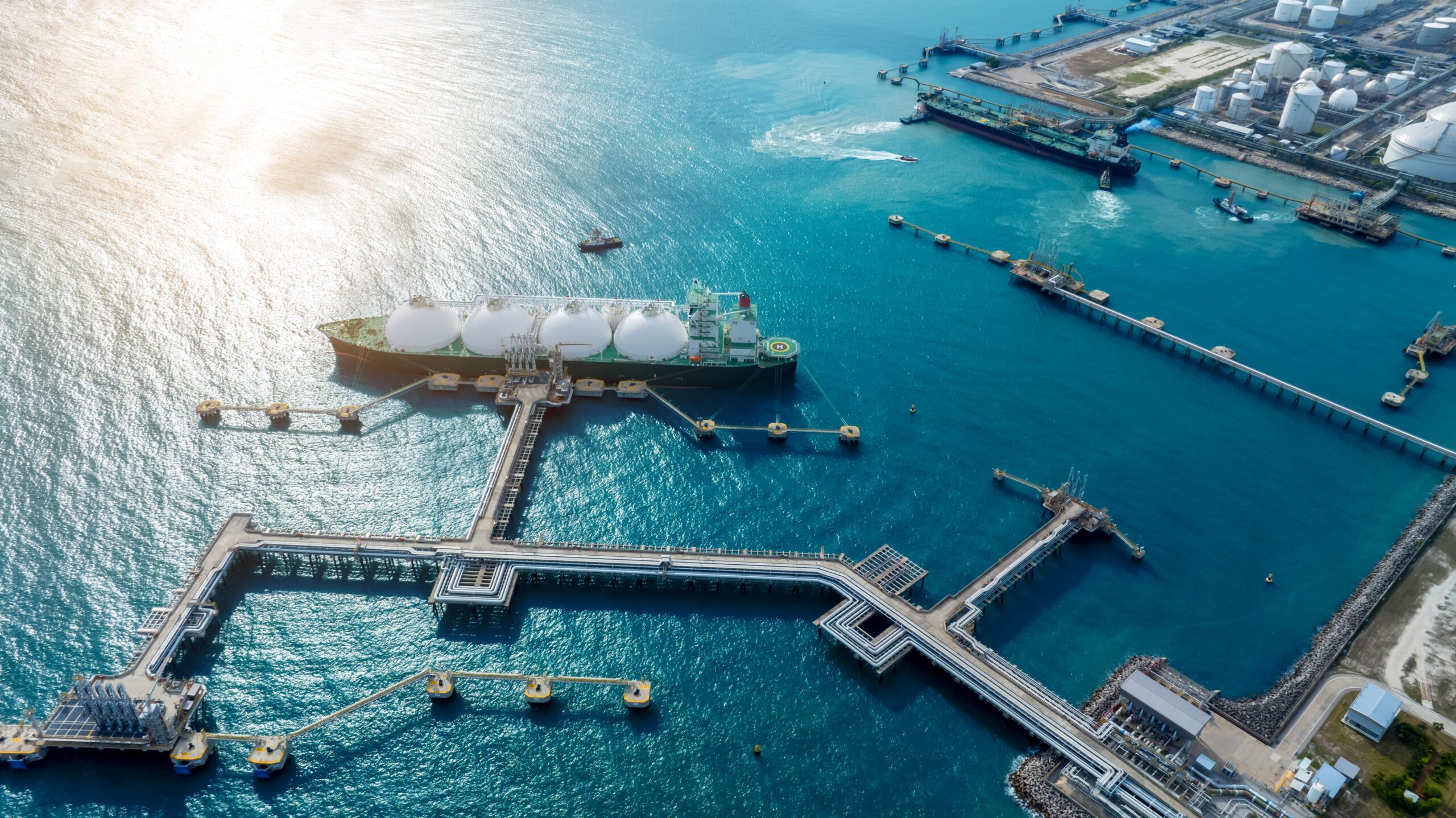
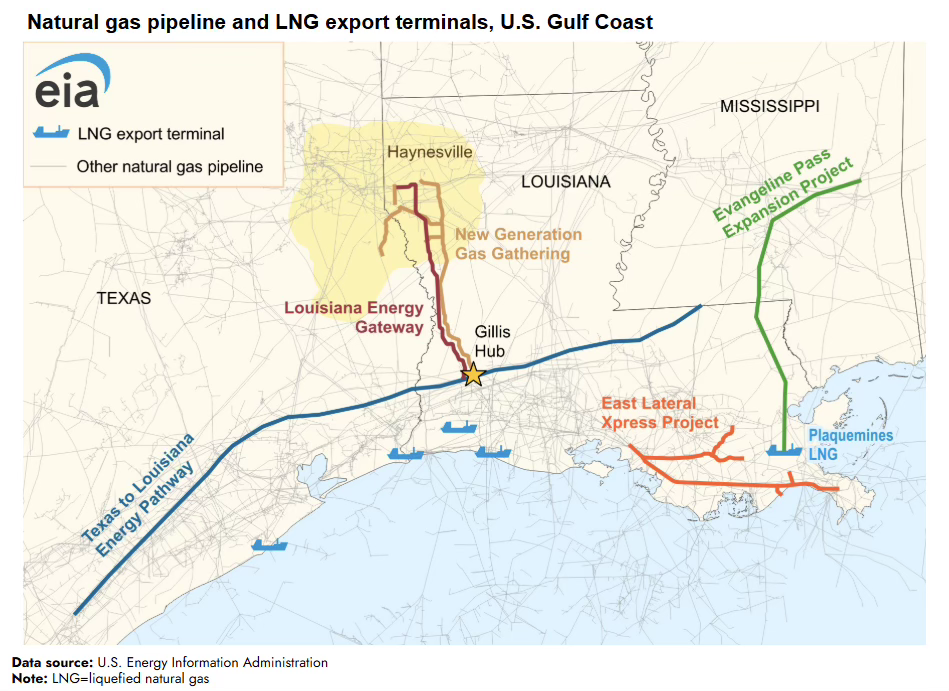
About 6.3 billion cubic feet per day (Bcf/d) of new natural gas pipeline capacity was added in 2025, according to the U.S. Energy Information Administration (EIA). 85% of that expansion is in the South Central region, which includes Texas, Louisiana, and other Gulf Coast states.
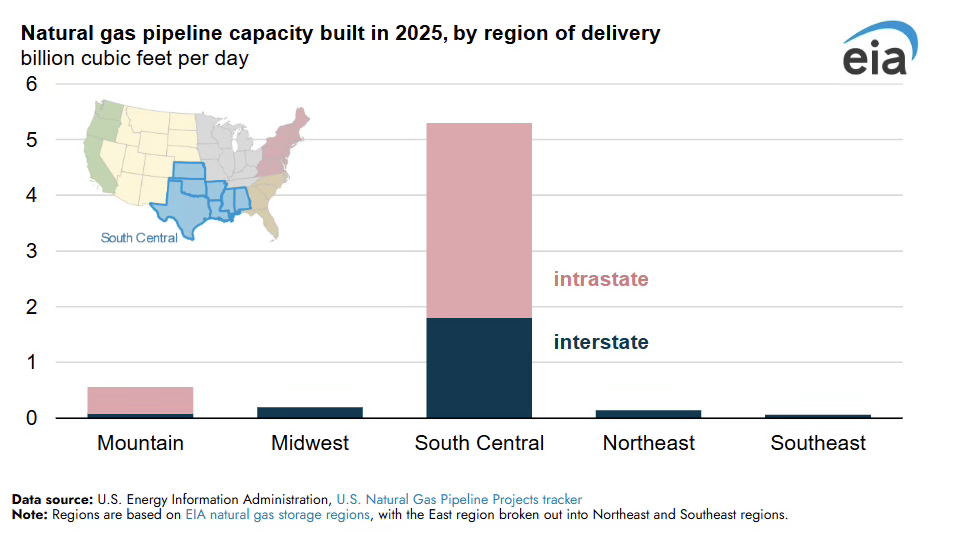
On the surface, this is predictable upstream infrastructure data, reinforcing the Gulf Coast’s role as the center of U.S. gas production and LNG exports. But it has major repercussions for all energy-intensive industries – especially data centers. When connection to the electric grid is unreliable, expensive, and time-consuming, microgrids connected to natural gas capacity can provide the power these industries need to continue their rapid growth instead.
The Gulf Coast is known for its economic prowess in oil and gas drilling, as well as petrochemical manufacturing. Soon, it will be a major data center hub too, based on recent projects established in the region. Real estate firm JLL found that more than half of all data center construction is occurring outside of the industry’s traditional hubs, and Texas is considered one of its top emerging markets. The state alone accounts for 6.5 GW of capacity under construction and could overtake Virginia as the largest global data center market by 2030.
The Gulf Coast is a logical “next frontier” for data center development. Texas and Louisiana are both states with ample available land and power, ranking 1st and 6th among states for total energy production, respectively. However, these statistics do not provide the full picture.
Texas has a robust grid drawing from a mix of renewables and baseload fossil fuels, further improved by grid upgrades following Winter Storm Uri. But this grid remains isolated from the Eastern and Western Interconnections and is still prone to failure due to imperfect weatherization and limited energy efficiency initiatives. At the same time, the state has enacted a “Kill Switch” bill that burdens large-load customers with interconnection study costs and mandates customer curtailment during emergencies.
Similarly, Louisiana has a significant baseload power supply in the form of natural gas and nuclear-powered electricity. It has three major data center campuses under development, including Meta’s largest data center yet. But is the state’s Public Service Commission ready for the spikes in energy demand from these projects? After the Louisiana PSC approved a “lightning speed” regulatory framework to accelerate power plant approvals for data centers, the Louisiana Energy Users Group voiced concerns over rising prices for legacy industrial and residential customers, arguing that tech firms should be shouldering more of the infrastructure costs.
So even in energy-rich regions like the Gulf Coast, data centers and other industrial customers are facing rising costs, stricter regulations, and unreliable power supply. How can these customers get the power they need quickly? The answer lies in combined-heat-and-power microgrids along the Gulf Coast, that have easy access to natural gas capacity without the myriad complications of grid interconnection.
The Industrial Power Resilience Equation
Natural gas infrastructure expansion does not eliminate grid constraints, but it strengthens the foundation for diversified energy architectures.
Onsite natural gas generation – particularly when configured with Combined Heat and Power (CHP) and advanced microgrid controls – can provide:
- Dispatchable baseload capability
- Island-mode operation
- Black start functionality
- Improved overall system efficiency
For AI-driven and high-density compute environments, where continuous uptime is non- negotiable, dispatchable infrastructure is core to reliability planning, instead of only operating as backup power.
As electric interconnection timelines lengthen and regulatory scrutiny of large loads increases, diversified energy strategies are becoming central to data center development. Gas infrastructure growth signals continued optionality for projects that pair utility supply with onsite generation and microgrid capability. Infrastructure trends, such as the Gulf Coast natural gas capacity buildout, are rarely just statistics. They are forward-looking signals that are critical for data centers competing on speed, resilience, and scalability.
Energy insights, delivered
Subscribe for more content.
Related Blogs

Unison Energy and Sonoma Valley Hospital Build Microgrid System to Make Hospital More Resilient During Natural Disasters
Power Under Pressure: Grid Risk, Extreme Weather, and the Case for Onsite Power
Onsite Generation – Part of the Power Stack