How Businesses Can Reduce Exposure to Rising Electricity Costs.
Blog
Energy Cost savings
The business impact of 40% higher electric rates.
Commercial and industrial electricity rates have increased by an average of 28% nationwide since 2020, with some regions experiencing increases exceeding 40%. As utilities continue investing in grid infrastructure and electricity demand grows, many organizations are exploring onsite microgrids and Energy-as-a-Service (EaaS) to improve long-term energy cost certainty and operational resilience. If rising utility costs are impacting your organization, Unison Energy can help evaluate whether an onsite energy solution is the right fit.
Prominent news outlets and energy-centric publications alike have sounded the alarm on rising electricity prices across the United States. While much of the coverage has focused on the impact on homeowners, commercial and industrial (C&I) organizations are facing similar challenges, with increasing pressure on operating costs and long-term energy planning. As utilities continue investing in grid modernization and demand for electricity accelerates, businesses should expect electricity costs and rate volatility to remain a long-term challenge.
Electric Rates Have Increased 28% Over the Past Five Years
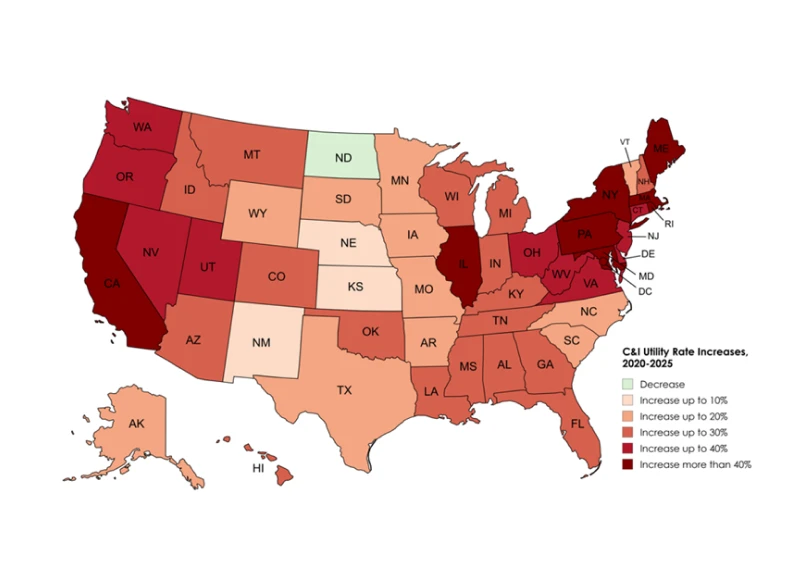
An analysis of data from the U.S. Energy Information Administration (EIA) found that average commercial and industrial electricity rates increased 28% nationwide between 2020 and 2025, with several regions experiencing increases exceeding 40%.
Electric Rate Escalations in the United States C&I Sectors, 2020-2025
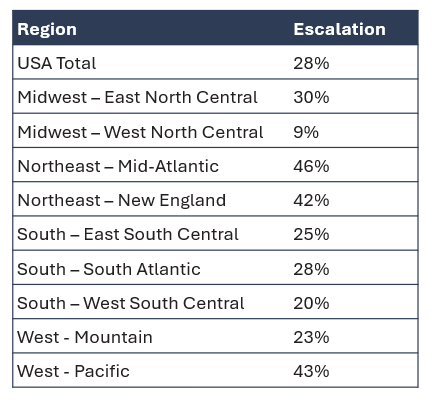
Note: Regional groups determined by Census Regions and Divisions of the United States. Combined C&I electricity rates are a weighted average of commercial and industrial rates, by kWh consumed in each state. Data sourced from EIA, not adjusted for inflation.
Electric Rate Escalations in the United States C&I Sectors, 2020-2025
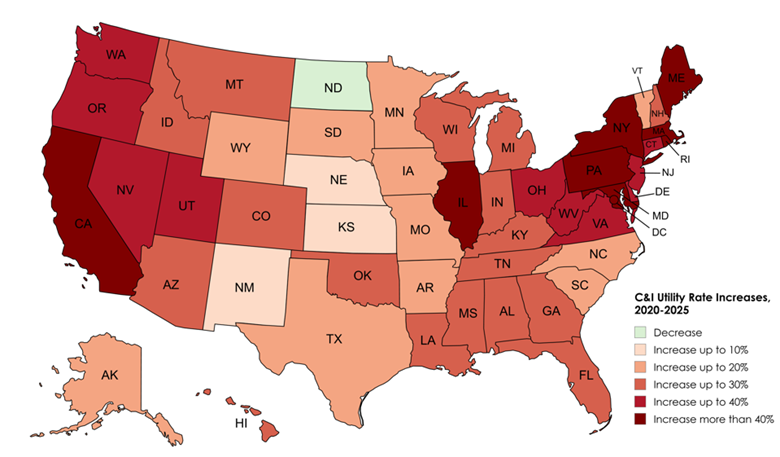
Electricity prices in the United States vary greatly across regions, and even across counties in the same state. A major driver are utilities often having monopolies over local electric grid operations. This allows for internally determined rate hikes before requesting approvals, resulting in energy consumers’ electric rates doubling just by crossing a county line in some regions.
For example, within New Jersey, business customers in Jersey Central Power & Light Company service areas pay an average of 14.95 cents per kWh. But in a neighboring utility’s service areas (Atlantic City Electric Company), business customers pay an average of 19.27 cents per kWh – 29% more.
Business Electric Rate Escalations in New Jersey, 2020-2024
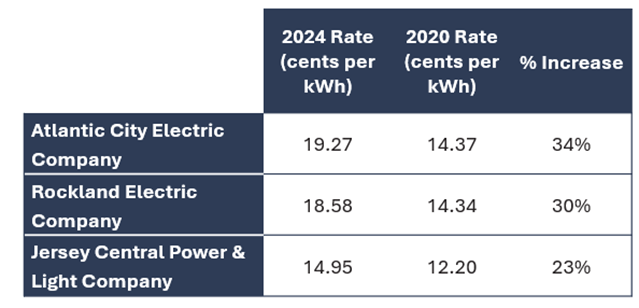
Note: Data sourced from S&P Global, calculated using a weighted average of commercial and industrial consumers.
Businesses are grappling not only with inflation, but also with unpredictable electric rate increases that often outpace it, making day-to-day operating costs highly volatile.
Nowhere Is Truly Safe From Unpredictable Electric Rate Increases
Rising electric rates cannot be explained by one factor alone. Skyrocketing demand is a vital component – according to the EIA, commercial electricity use is expected to surpass residential use in 2027, for the first time on record – but costly grid upgrades and delays to generation build-out play a role too. Severe weather and climate change are also driving up costs.
The Rocky Mountain Institute reports that utilities’ return on equities (ROEs) have become increasingly generous since the 1990s and are higher than required to continue operating and expanding the electric grid. So while there are legitimate reasons for the record-breaking $31 billion in rate increases in 2025, many rate increases are also opportunistic.
Escalation in Selected Electric Rates across the United States, 2020-2024
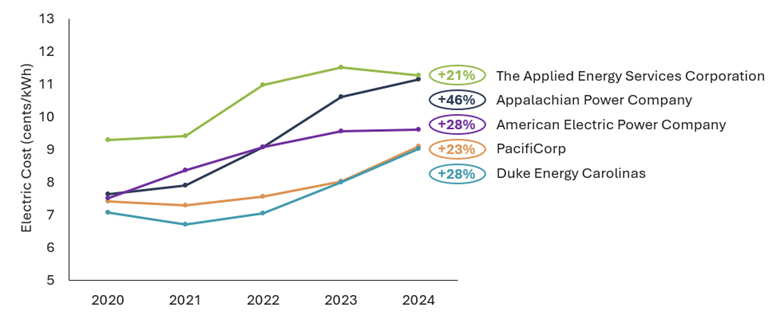
As a result, though some regions have seen electric rates escalate faster than others, nowhere is truly safe from unpredictable increases in the coming years. Even in North Dakota, the one state that experienced falling electricity prices since 2020, utility regulators approved a 10.37% overall rate increase for Xcel Energy this year – after negotiating it down from the initially requested 19.34% increase.
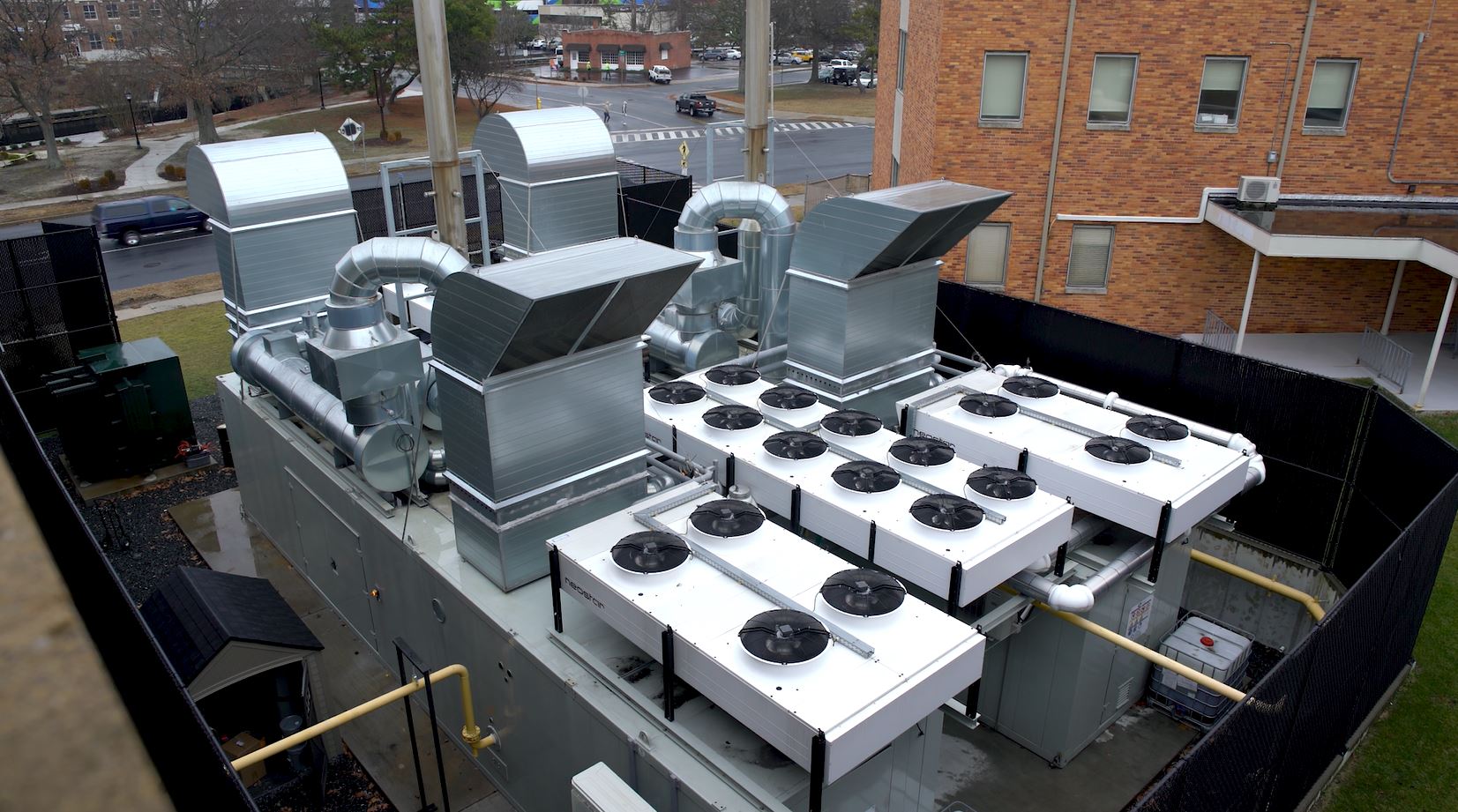
To reeduce exposure to unpredictable utility rate increases, many commercial and industrial organizations are turning to onsite microgrids delivered through an Energy-as-a-Service (EaaS) model. Unlike relying solely on utility power, onsite microgrids generate electricity and thermal energy at the facility, helping organizations reduce exposure to utility rate volatility while improving operational resilience. Unison Energy has deployed onsite energy systems for hospitals, manufacturers, commercial real estate, hospitality properties, and other energy-intensive facilities across North America, helping customers achieve greater energy cost certainty through long-term energy service agreements with predictable power pricing and a fixed 2.5% annual escalator.
Electric Rate Increases Are Set to Continue for Years
Utility rate volatility is no longer a temporary challenge – it has become a structural cost of doing business. As utilities continue investing in grid modernization, transmission expansion, and resiliency upgrades, commercial and industrial energy users should expect upward pressure on electricity prices to continue. Organizations that take a proactive approach today will be better positioned to manage long-term operating costs while reducing their dependence on an increasingly unpredictable electric grid.
If your facility spends more than $1 million annually on electricity or is evaluating strategies to improve energy cost certainty and operational resilience, Unison Energy can help quantify the opportunity. Our team can perform a preliminary assessment of your facility’s energy profile and determine whether an onsite microgrid could deliver meaningful long-term savings, greater energy resilience, and protection from future utility rate volatility.
As utility prices soar across the country over the coming years, your business must be prepared to respond. Request a preliminary energy assessment to understand whether an onsite microgrid could reduce long-term energy costs and improve resilience at your facility.
—

ByCaroline Magdolen
Share on
Share on
About us
Engineered for Performance. Built for the Long Term.
Unison Energy combines capital strength, technical expertise, and operational discipline to deliver resilient power for facilities across industries.
Related posts
Insights shaped by over a decade of experience
Explore more perspectives on energy costs, resilience, and on-site generation from the Unison Energy team.
View All Blogs