A Short Power Outage, a Long Recovery: What Food and Beverage Plants Can Do About It
Blog
Food & beverage
Key Takeaways:
- A short utility outage can mean hours of recovery for a food or beverage plant, because refrigeration, sanitation, and production systems often need to be restored before a line can restart.
- Operators can’t control the grid, but they can take greater control of how the plant is powered.
- CHP produces electricity and useful heat from one fuel input, and a CHP-based microgrid can be designed to keep selected loads running during an outage.
- Under Energy-as-a-Service, Unison Energy finances, owns, operates, and maintains the system, so the plant doesn’t take on the upfront capital or day-to-day operations.
For a food or beverage plant, a power interruption can mean more than lost production time. In aseptic processing (sterile processing and packaging), an outage as short as an hour can breach required processing conditions, leading to product losses and re-sterilization before production resumes.1
Filling lines, ovens, cookers, and packaging equipment stop when power is interrupted. So do the compressors and controls that keep cold storage, blast freezing, and process cooling within specification. Hot water, steam, and clean-in-place systems also depend on power, and a line often can’t restart until those systems are back online.² When they are down as well, the outage on the utility clock and the interruption on the production clock are not the same length.
That gap is the operating problem. Spoilage, a missed shipment, a restarted sanitation cycle, and a crew standing by all surface after the lights come back on. For a plant that runs extended hours and sells into a cold chain, even a brief interruption can jeopardize inventory that took hours to produce and cannot be remade on the original schedule. Industrial operators surveyed by ABB report downtime costing an average of about $170,000 an hour.3 In a business where margins are already thin,⁴ wasted product is not only an energy issue but also a production issue.
Operators cannot control utility rates, regional power markets, or how quickly the grid is restored. They can take greater control of how the plant is powered, including the heat the process already requires each day.
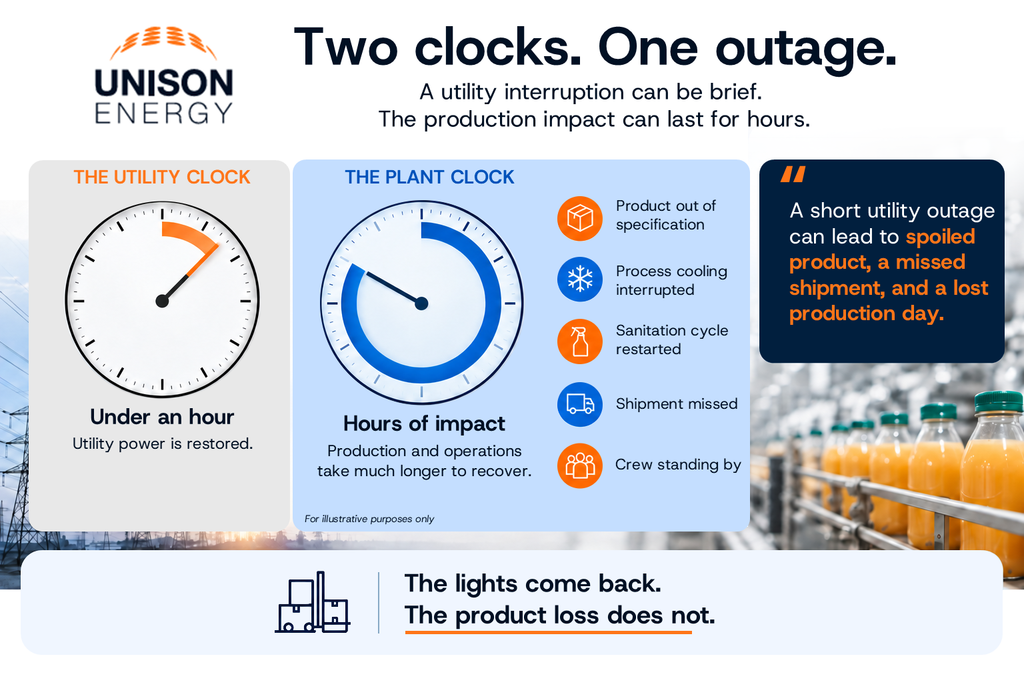
A brief utility outage can cause hours of operational disruption. For food and beverage plants, the real impact is measured in spoiled product, restarted sanitation, missed shipments, and lost production, not just minutes without power.
CHP for food and beverage plants: resilient power plus recovered heat.
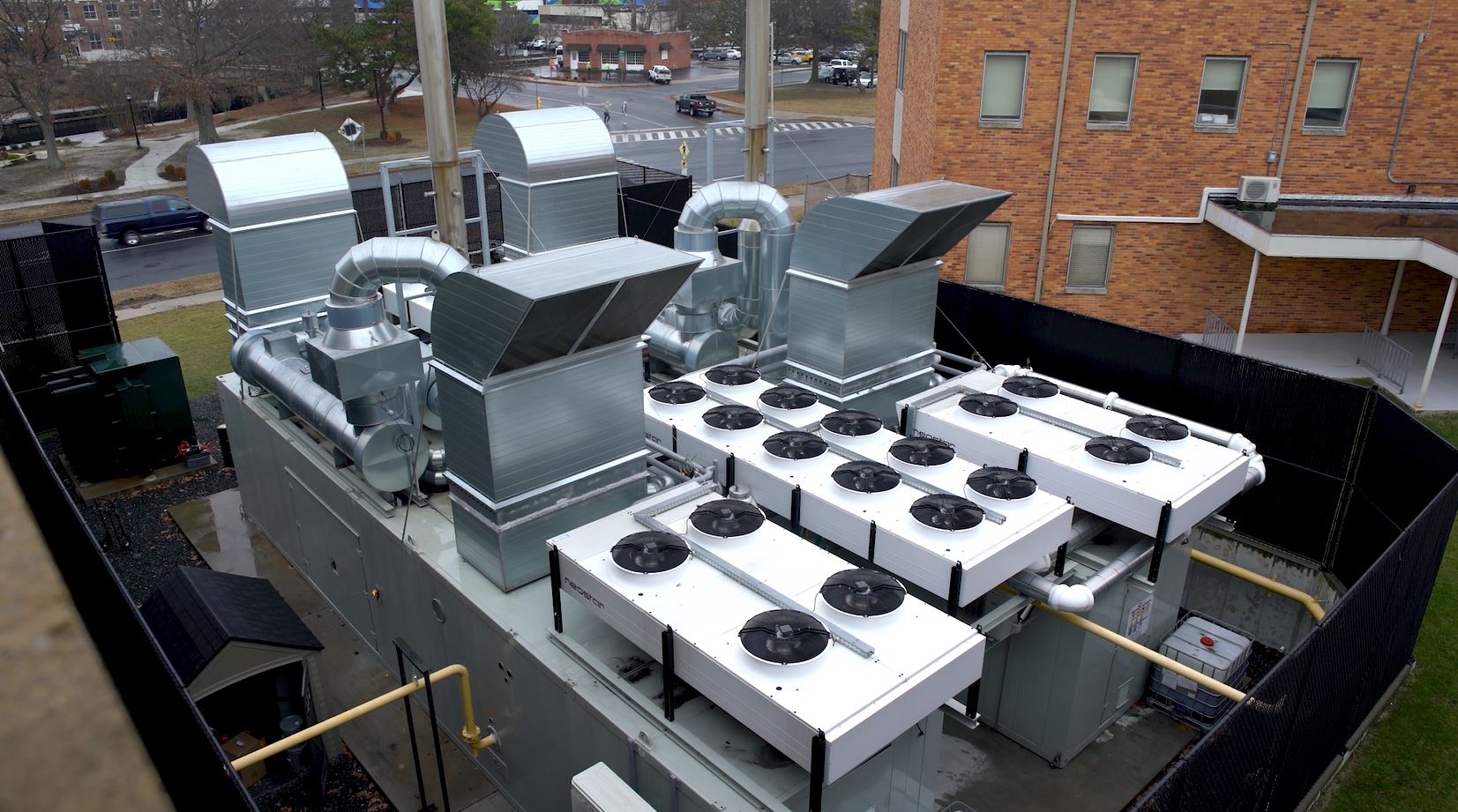
Onsite generation, designed around the plant’s electric and thermal loads, can reduce dependence on the grid during normal production and lower exposure when utility power is unavailable. Combined heat and power (CHP), also called cogeneration, is often a strong fit because a single fuel input produces both electricity and useful heat. Electricity can power production equipment, refrigeration compressors, and controls. Recovered heat can supply hot water, steam, cleaning, pasteurization, or, where an absorption chiller is appropriate, a portion of the cooling load. Because CHP captures heat that would otherwise be wasted, it can improve total system efficiency. A standby generator supports emergencies; CHP is designed to run as a daily energy asset.
When CHP is paired with microgrid controls, the result is a CHP-based microgrid: an onsite system that generates, manages, and distributes electricity in parallel with the utility and, when designed to do so, can operate independently during an outage. Island-mode capability can allow selected loads, such as production lines, refrigeration, and sanitation, to continue operating. That capability depends on system configuration, available generation, fuel supply, operating conditions, and maintenance status. A CHP-based microgrid does not eliminate every outage, equipment failure, or fuel constraint. It is designed to reduce the likelihood that a grid event results in lost product.
This matters on the plant floor. The practical question is not whether the facility can disconnect from the utility. These systems are designed to operate alongside the grid. The question is whether refrigeration, hot water, and the line can be designed to keep running through events that halt a shift, without asking the operations team to become a power-plant operator.
Take Greater Control of Your Plant’s Power with Energy-as-a-Service
Under Energy-as-a-Service (EaaS), Unison Energy can finance, design, build, own, operate, and maintain the onsite system. Under a long-term Energy Services Agreement, the customer purchases electricity and, where the system produces it, thermal energy without making an upfront capital investment or assuming day-to-day operating responsibility. Because Unison continues to own and operate the system after commissioning, it remains accountable for long-term monitoring, maintenance, and lifecycle planning.
The fit is practical, not universal. The strongest candidates have sustained electrical demand, a meaningful thermal load for sanitation or process heat, and downtime costs that leadership already understands. Space, fuel access, permitting, and the ability to integrate with existing electrical and thermal systems determine feasibility. When those conditions are present, onsite power can reduce exposure to the hours when a grid interruption spoils product, forces a line to be re-sanitized, or turns a short outage into a lost production day.
What food and beverage operators need is simple: cold storage that stays cold and sanitation water that stays hot when utility power fails, without diverting capital from the plant itself. Onsite generation, including CHP, can be designed to support exactly that.
If a short outage costs your plant more than minutes, talk with our team about your facility’s electric and thermal loads. We’ll help you see whether onsite generation could be a fit.
Sources
- U.S. Food and Drug Administration. “Aseptic Processing and Packaging for the Food Industry.” Inspection Guides. https://www.fda.gov/inspections-compliance-enforcement-and-criminal-investigations/inspection-guides/aseptic-processing-and-packaging-food-industry. Accessed October 2026.
- CSI Designs. “5 Steps in a Common Food, Dairy & Beverage Clean-in-Place Cycle.” https://www.csidesigns.com/blog/articles/5-steps-in-a-common-food-dairy-beverage-clean-in-place-cycle. Accessed October 2026.
- Thompson-Richards, Alyse. “How Much is Food Manufacturing Downtime Costing You?” Food Engineering, January 20, 2026. https://www.foodengineeringmag.com/articles/103472-how-much-is-food-manufacturing-downtime-costing-you
- Damodaran, Aswath. “Margins by Sector (US).” NYU Stern School of Business, data as of January 2026 (Food Processing: 2.8% net margin). https://pages.stern.nyu.edu/~adamodar/New_Home_Page/datafile/margin.html. Accessed October 2026.
ByUnison Energy
Share on
Share on
About us
Engineered for Performance. Built for the Long Term.
Unison Energy combines capital strength, technical expertise, and operational discipline to deliver resilient power for facilities across industries.
Related posts
Insights shaped by over a decade of experience
Explore more perspectives on energy costs, resilience, and on-site generation from the Unison Energy team.
View All Blogs