Beyond Backup: How Onsite CHP Can Lower Hospital Energy Costs in PJM
Blog
Healthcare
Key Takeaways:
- Code compliance is the floor, not the goal: Code-required emergency generators support designated critical loads but typically do not reduce daily electricity costs or capacity charges.
- Onsite generation can help manage costs: CHP can reduce purchased electricity and, depending on system operation and tariffs, lower the peak demand used to calculate capacity charges.
- CHP supports electricity and heating needs: Recovered heat can serve sterilization, hot water, and space heating, while a CHP-based microgrid designed for island mode can support designated loads during outages.
- Hospitals can preserve capital for patient care: Unison Energy’s Energy-as-a-Service model provides onsite generation without upfront investment or day-to-day operating responsibility.
A standby generator that meets the code does not cut the capacity charge.
Hospitals in the PJM Interconnection, the largest regional grid operator in North America, can meet life-safety code requirements yet remain exposed in two ways: once when utility power is interrupted and again when the capacity charge appears on the bill. A hospital does not aim to simply meet legal requirements. Why should its energy system?
PJM’s footprint includes all or part of Delaware, Illinois, Indiana, Kentucky, Maryland, Michigan, New Jersey, North Carolina, Ohio, Pennsylvania, Tennessee, Virginia and West Virginia, as well as the District of Columbia.
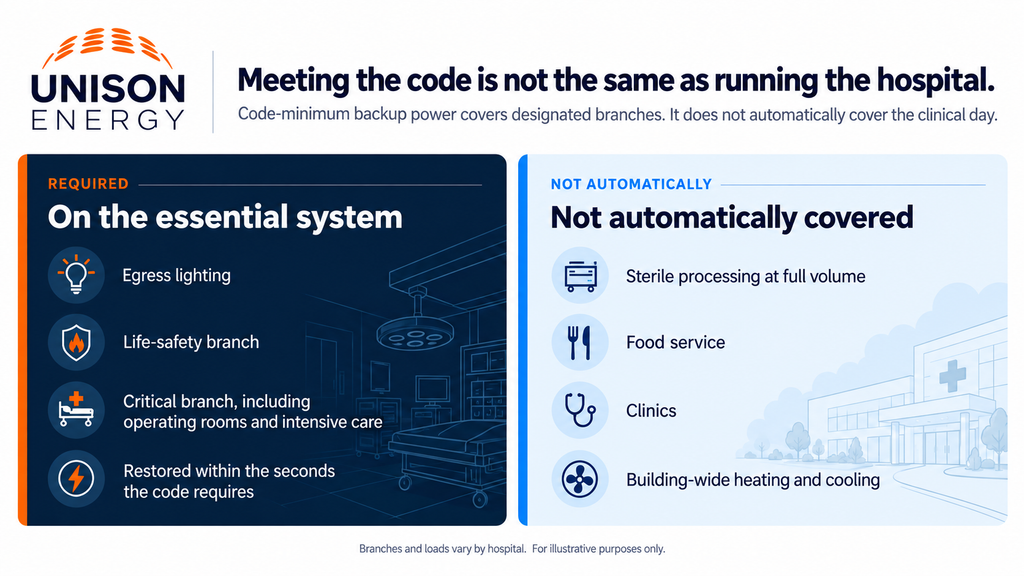
Emergency generators are not optional. They are designed to restore designated life-safety and critical branches within seconds, as required by NFPA code.1 That is the floor the code sets. It is not designed to power the full campus every day.
What does code-minimum backup power cover?
The required system is sized for designated branches, not for every load on the campus. Operating rooms, intensive care, and egress lighting sit on one side of that line. A full day of sterile processing, food service, clinics, and building-wide heating and cooling may not. When a short utility interruption occurs, the difference can show up as delayed procedures, a sterilization backlog, and pressure on the clinical schedule.
Those generators are built to remain on standby. Most run only during emergencies or tests.2 They do not produce the steam and hot water a hospital uses every hour. Because they sit idle on a normal day, they typically do not reduce the electricity the hospital buys or the peak that triggers capacity charges. The hospital still pays to own and maintain that equipment, even though it does little for the energy bill on a normal day. These systems are designed to operate alongside the grid, not instead of it.
PJM capacity prices have risen more than tenfold.
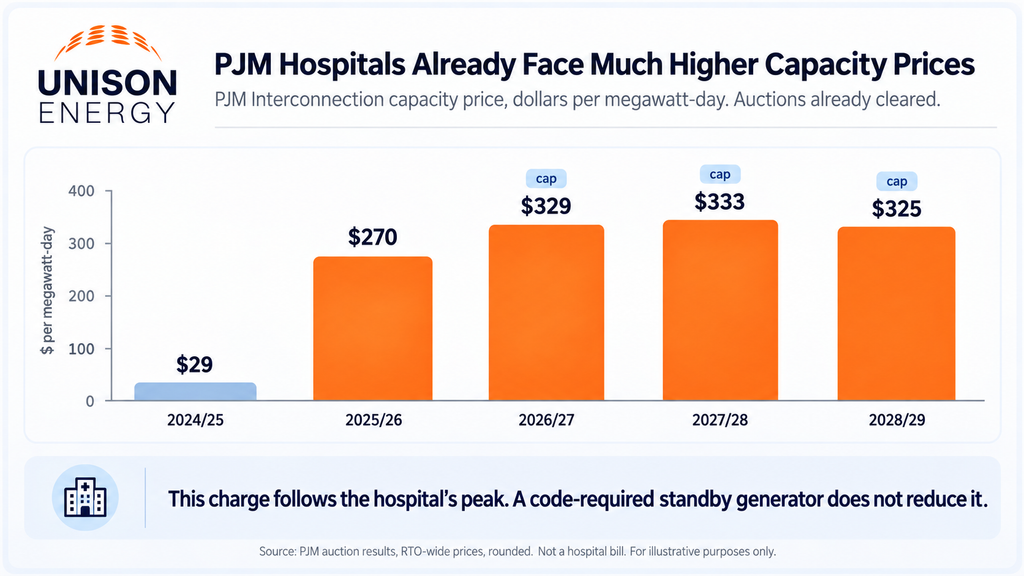
The power for hospitals across PJM is bought in the same auction, and the capacity price has been reset. The 2024/25 auction cleared near $29 per megawatt-day RTO-wide.3 The 2025/26 auction cleared near $270.3 The next three delivery years each cleared over $320/MW-day4–6—each more than 10x the 2024/25 price. A price cap and floor applied across PJM kept later prices from going higher.7 It did not restore the old prices.
The charge is applied to the hospital’s demand when grid demand is highest. A code-required generator in the yard typically does not reduce that peak, so a compliant hospital can still pay the higher price for the same load. Increased capacity charges can now make up a larger share of the energy bill, and the facility cannot control the market price.
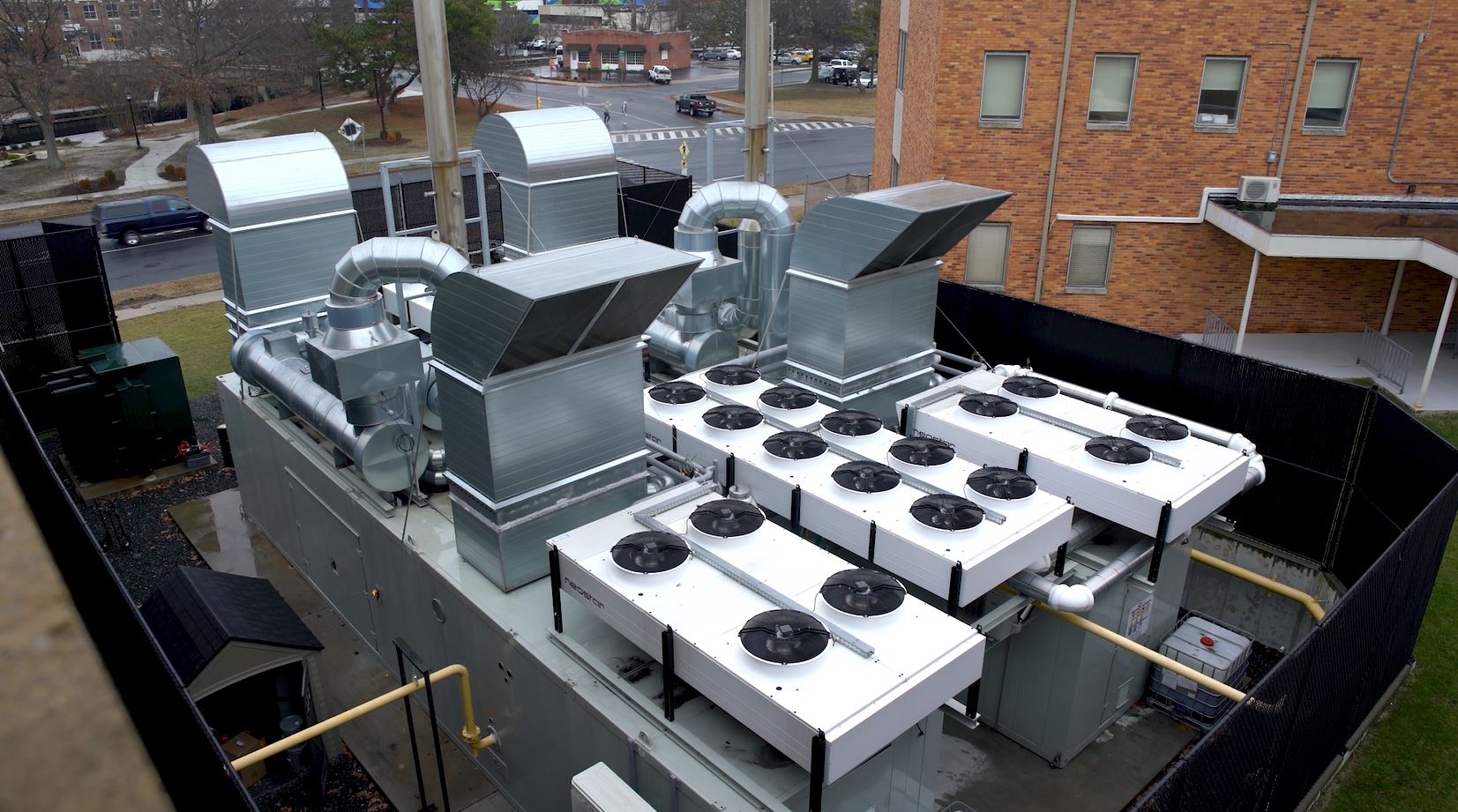
Onsite generation, designed to match the hospital’s electric and thermal loads, can reduce purchased electricity. Depending on the tariff, configuration, and operation, it can also lower the peak that determines the capacity charge. Combined heat and power (CHP), also called cogeneration, is often a good fit because a single fuel input produces electricity and useful heat. Electricity can support the campus, reducing energy and capacity charges, while recovered heat can support sterilization, domestic hot water, and space heating.
CHP is a form of onsite generation. It does not replace the code-required emergency system. A standby generator remains on standby. CHP is designed as a daily energy asset, and when it is configured for island mode as part of a CHP-based microgrid, it can support designated loads during an outage. It does not eliminate every outage or fuel constraint.
How Energy-as-a-Service keeps capital focused on patient care
Paying for onsite generation from hospital capital accounts would divert funds from imaging, staffing, and the next clinical project. Under an Energy-as-a-Service (EaaS) agreement, Unison Energy can finance, design, build, own, operate, and maintain the onsite system. Under a long-term Energy Services Agreement (ESA), the hospital buys electricity from Unison and, where the system produces it, thermal energy, without upfront investment or day-to-day operating responsibility.
Further, onsite generation can add capacity on the hospital’s side of the meter on the campus timeline, rather than through an interconnection queue. Space, fuel, permitting, and the actual loads determine whether that is feasible.
Because Unison continues to own and operate the system after commissioning, it remains accountable for monitoring, maintenance, and lifecycle planning for the 15 to 25 years these agreements typically run.8
Code-minimum backup remains the hospital’s required emergency layer. The daily energy system is a separate decision. It determines what the hospital pays for energy and how much of the clinical day depends solely on the utility. It is also where a hospital can set a higher bar than just meeting the code.
See whether onsite generation or CHP is a good fit for your facility. Contact Unison Energy to request a complimentary no-obligation energy assessment.
Sources
- National Fire Protection Association. NFPA 99: Health Care Facilities Code, 2024 edition, p. 97 of PDF. Accessed October 2026.
- U.S. Environmental Protection Agency. Catalog of CHP Technologies, p. 29 of PDF. Accessed October 2026.
- PJM, 2025/2026 Base Residual Auction Report, Table 2: $28.92 per megawatt-day for 2024/25 and $269.92 for 2025/26 (RTO-wide).
- PJM, 2026/2027 Base Residual Auction Report: $329.17 per megawatt-day for 2026/27, the cap.
- PJM news release, Dec. 17, 2025 and the 2027/2028 auction report: $333.44 per megawatt-day for 2027/28, the cap.
- PJM news release, July 14, 2026 (2028/2029 Base Residual Auction results): $325 per megawatt-day for 2028/29, the cap. Accessed October 2026.
- PJM 2025 Annual Report, Markets (price cap and floor): about $325 per megawatt-day cap and about $175 floor. The report covers the 2026/27 and 2027/28 auctions
- Unison Energy. On-Site Power Generation FAQs. Accessed October 2026.
Tenfold figure calculated from the 2024/25 ($28.92) and 2028/29 ($325) RTO clearing prices.

ByUnison Energy
Share on
Share on
About us
Engineered for Performance. Built for the Long Term.
Unison Energy combines capital strength, technical expertise, and operational discipline to deliver resilient power for facilities across industries.
Related posts
Insights shaped by over a decade of experience
Explore more perspectives on energy costs, resilience, and on-site generation from the Unison Energy team.
View All Blogs