Onsite Power for Pharma: Don’t Let an Outage Cost a Batch
Blog
Pharma
Key Takeaways:
- Code compliance is the floor, not the goal: Code-required emergency generators support designated critical loads but typically do not reduce daily electricity costs or capacity charges.
- Onsite generation can help manage costs: CHP can reduce purchased electricity and, depending on system operation and tariffs, lower the peak demand used to calculate capacity charges.
- CHP supports electricity and heating needs: Recovered heat can serve sterilization, hot water, and space heating, while a CHP-based microgrid designed for island mode can support designated loads during outages.
- Hospitals can preserve capital for patient care: Unison Energy’s Energy-as-a-Service model provides onsite generation without upfront investment or day-to-day operating responsibility.
The plant can be restarted. The batch in the vessel may not be releasable.
A pharmaceutical plant that experiences a utility power outage may resume operations the same day and still have nothing to release. In New Jersey alone, about 29,300 people worked in pharmaceutical and medicine manufacturing as of August 2026.1 Pharmaceutical plants run processes within written limits, such as temperature, pressure, humidity, airflow, and time. Loss of utility power can push batches outside those limits in minutes. The building can be reoccupied, but the in-process batch may not be releasable.
What does a grid interruption do to a pharmaceutical batch?
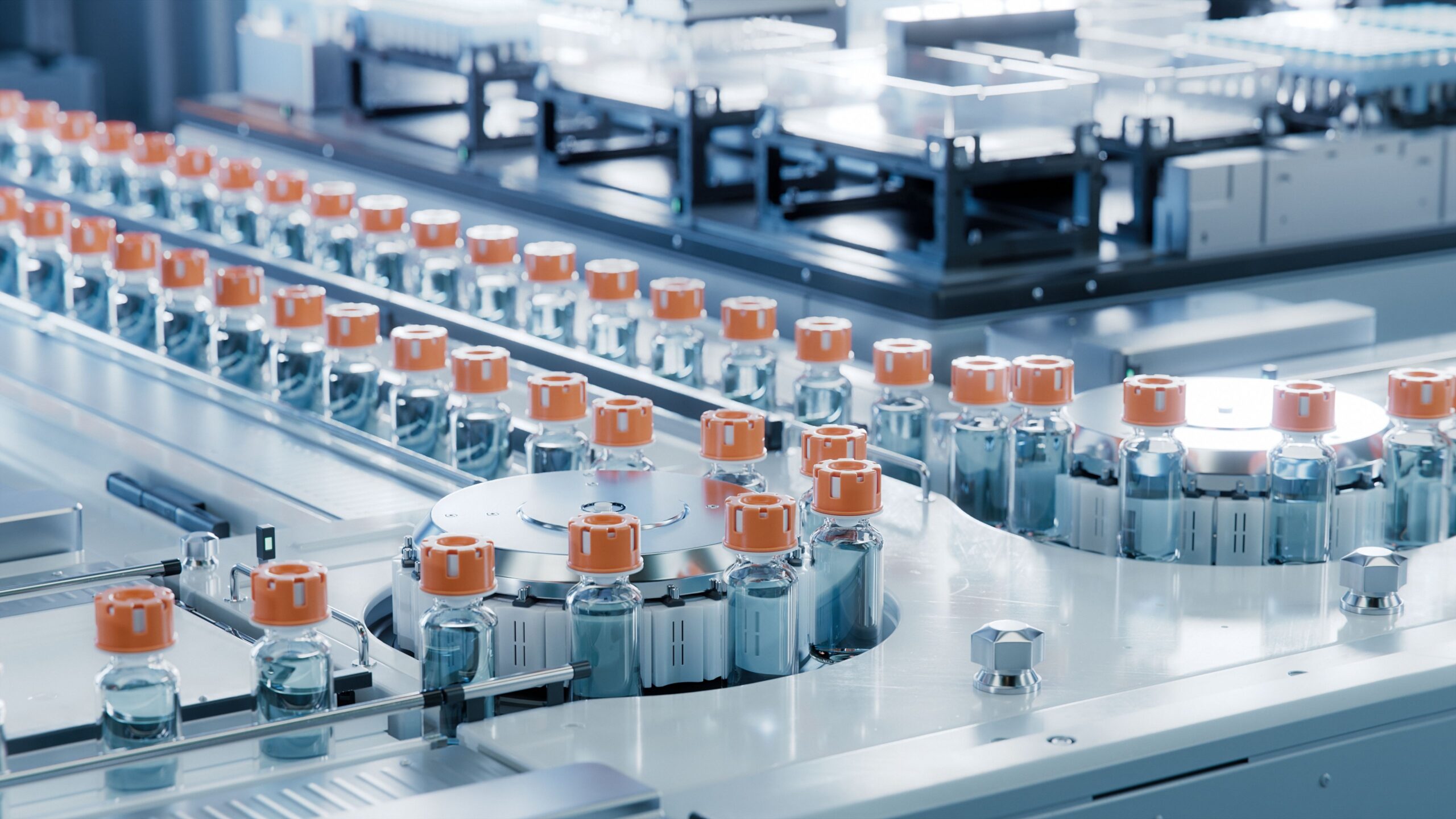
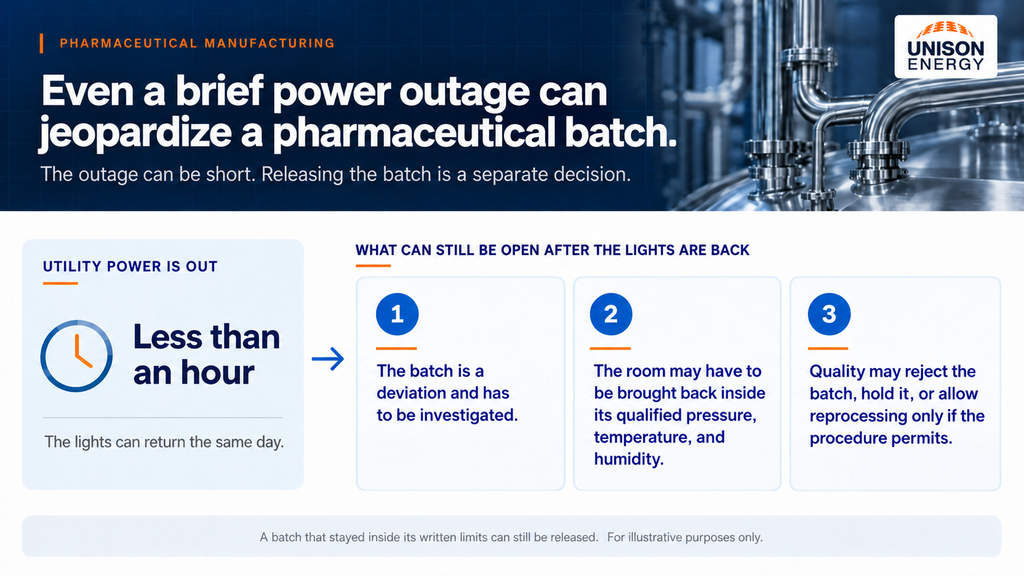
A grid interruption can push a batch outside its written limits, which triggers a deviation review before anyone can release it. Before releasing a batch, the quality unit reviews the production and control records. Under 21 CFR 211.192, an unexplained discrepancy or a failure to meet a specification must be investigated, including other batches that may have been affected.2
Under 21 CFR 211.100, a deviation from the written procedure must be recorded and justified.3 A lyophilizer that warmed, a bioreactor that lost temperature and agitation, or a filler that lost its air supply is a deviation for the quality unit to assess. If the investigation shows no impact on product quality, quality can release the batch. If not, it may reject the batch, hold it, or allow reprocessing only where the procedure permits.
Which loads may standby power not carry?
Room air handling, chillers, process refrigeration, and compressed air may not be connected to the emergency generator. Where the process requires it, 21 CFR 211.46 calls for control of air pressure, microorganisms, dust, humidity, and temperature.4 Fans, chillers, and heaters maintain those conditions, and they stop when power is lost. A room can quickly fall out of its qualified pressure requirements. Exposed product is then outside the environment the batch record assumed. Product that must stay cold has the same problem if process refrigeration or storage temperature is lost.
A standby generator is designed to carry designated emergency loads. An air permit commonly limits the hours it may run for testing while the utility is available. Air handlers that maintain room pressure, chillers in the cold rooms, and the compressors that supply compressed air to the process ordinarily remain on utility power. The standby generator and the utility ordinarily supply the facility one at a time.
Does a standby generator lower demand and capacity charges?
Generally, no. Industrial electric bills often carry two peak-based charges. The demand charge is a retail charge, calculated from the plant’s own peak. The capacity charge reflects the plant’s share of the system’s peak. In PJM, the grid operator for New Jersey and much of the Mid-Atlantic, it is settled in the PJM market and calculated from the plant’s load during the system’s peak hours. Emergency equipment that was offline at those hours does not reduce either charge.
How can combined heat and power support a pharmaceutical plant?
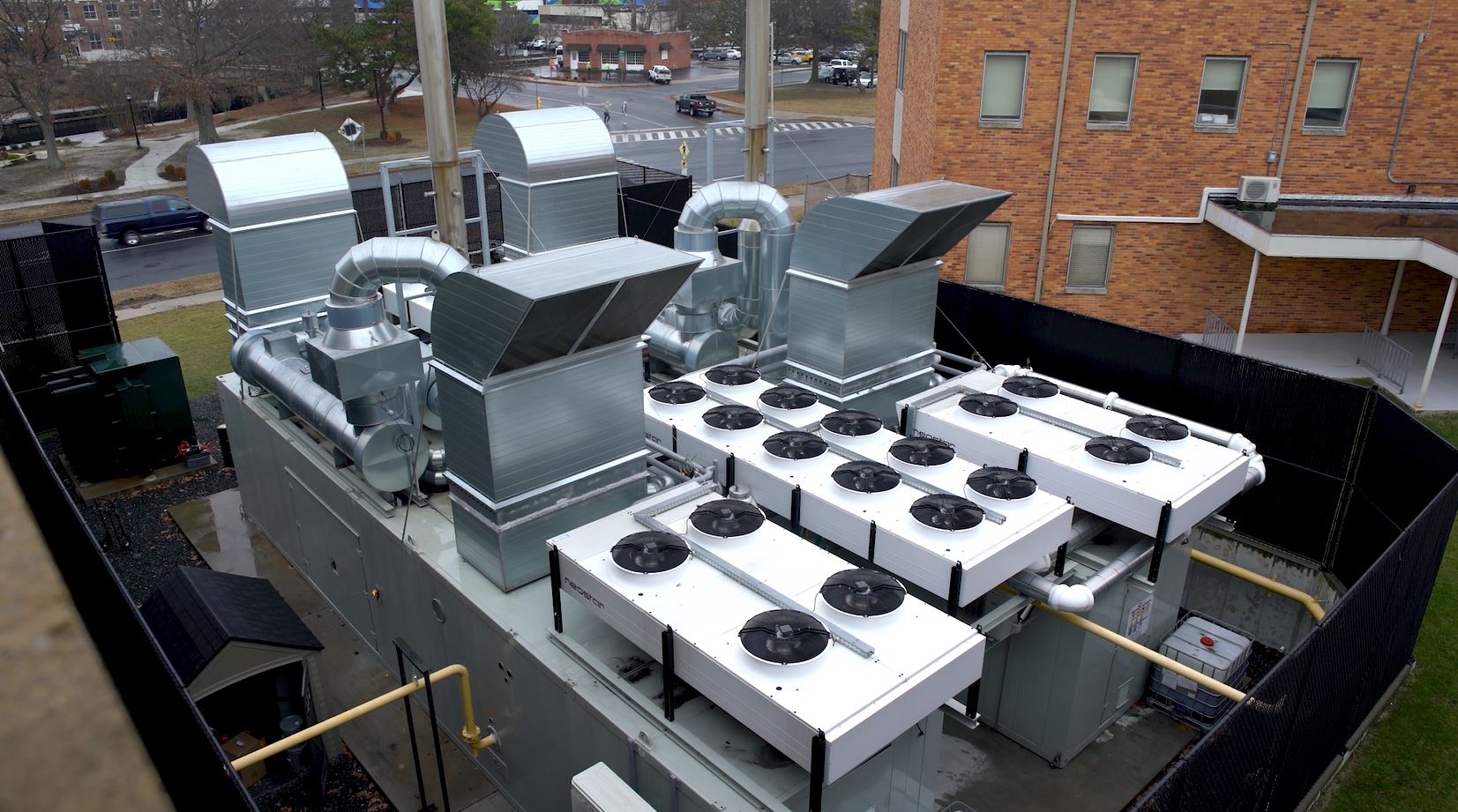
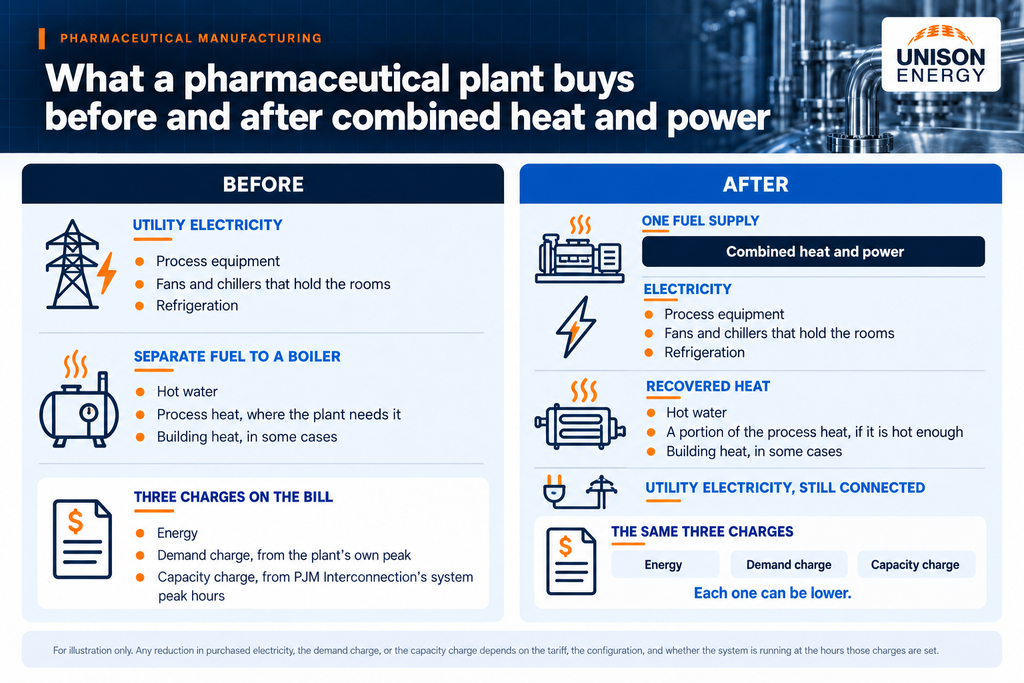
A combined heat and power (CHP) system, also called cogeneration, can supply electricity for pharmaceutical production while recovering heat for hot water and suitable process or building heating needs. For a plant with substantial electricity and heat demand, producing both together can reduce the amount of electricity purchased from the utility.
The power can feed process equipment, the fans and chillers that maintain the environment, and the refrigeration. Heat from that generation can supply hot water and, if it is hot enough, a portion of the process heat, and in some cases heat for the building. Because CHP captures useful heat from the same fuel, it can improve total energy efficiency, which supports cost control and, depending on the site, can lower emissions compared with buying grid power and fueling boilers separately.
Exact savings depend on the tariff, how the system is configured, and when it runs. But in PJM, capacity is no longer a small part of the equation. Capacity prices jumped from about $29 per megawatt-day for 2024/25 to about $270 the next year, and recent auctions have cleared at the price cap, near $330.⁶ At those prices, every megawatt a plant takes off its peak is worth more, so onsite generation can have a larger effect on the bill. This is not the standby generator the site already operates. CHP is a form of onsite generation. It is designed to run through the production day, supplying power and heat. When configured for island mode as part of a CHP-based microgrid, the system can support selected loads during a grid outage and reconnect in parallel with the utility when service returns.
How does Energy-as-a-Service work for a pharmaceutical plant?
Operating a CHP plant requires a skill set distinct from process operations and plant maintenance. Unison Energy can own and operate that asset under an Energy-as-a-Service model: it finances, designs, builds, owns, operates, and maintains the system. Unison Energy remains the owner and operator for the 15 to 20 years a typical agreement runs, including monitoring, maintenance, and decisions on overhauls and replacements.5
Under an Energy Services Agreement, the manufacturer pays for the electricity and any thermal energy the CHP system produces. The capital that would have gone into the power plant stays with the manufacturer and can be invested in a new line, suite, or expansion.
You can’t control the grid. But with onsite power, you can take greater control of how your plant is powered, every day and not just in an emergency.
See whether onsite power could be a fit for your plant. Contact Unison Energy to request a free, no-obligation energy assessment.
Sources
- U.S. Bureau of Labor Statistics via FRED. All Employees: Manufacturing: Non-Durable Goods: Pharmaceutical and Medicine Manufacturing in New Jersey: about 29.3 thousand employees, seasonally adjusted, August 2026. Accessed October 2026.
- Code of Federal Regulations, Title 21. 21 CFR 211.192, Production record review: records are reviewed before release, and an unexplained discrepancy or failure to meet specifications must be investigated, including other associated batches. Accessed October 2026.
- Code of Federal Regulations, Title 21. 21 CFR 211.100, Written procedures; deviations: any deviation from written procedures must be recorded and justified. Accessed October 2026.
- Code of Federal Regulations, Title 21. 21 CFR 211.46, Ventilation, air filtration, air heating and cooling: equipment for control of air pressure, microorganisms, dust, humidity, and temperature shall be provided when appropriate. Accessed October 2026.
- Unison Energy. On-Site Power Generation FAQs: a long-term O&M agreement is a service contract, typically 15–20 years. Accessed October 2026.
- PJM, 2025/2026 Base Residual Auction Report, Table 2: $28.92 per megawatt-day for 2024/25 and $269.92 for 2025/26 (RTO-wide). PJM, news release, July 22, 2025 (2026/2027 Base Residual Auction results): $329.17 for 2026/27, the cap. PJM, 2027/2028 Base Residual Auction report: $333.44 for 2027/28, the cap. PJM, news release, July 14, 2026 (2028/2029 Base Residual Auction results): $325 for 2028/29, the cap. Accessed October 2026.

ByUnison Energy
Share on
Share on
About us
Engineered for Performance. Built for the Long Term.
Unison Energy combines capital strength, technical expertise, and operational discipline to deliver resilient power for facilities across industries.
Related posts
Insights shaped by over a decade of experience
Explore more perspectives on energy costs, resilience, and on-site generation from the Unison Energy team.
View All Blogs