Take Your Energy Price Off the Auction Block with Onsite Power
Blog
Energy Cost savings
Key Takeaways:
- Your facility’s energy bill is high today and, in markets like PJM, increasing fast. Capacity for an 8 MW load there costs about $960,000 a year, up from about $84,000 two years ago—an increase of more than 1,000%.
- Onsite generation, including combined heat and power (CHP), can counter rising costs by reducing the electricity a facility buys from the grid. Any effect on demand or capacity charges depends on the tariff and configuration.
- Under Energy-as-a-Service (EaaS), Unison Energy owns and operates the onsite power system, and the facility pays for electricity without upfront capital investment or day-to-day operating responsibility.
A facility can know last month’s energy use and still not know next month’s cost. The facility does not have to be the one reacting to it.
What can change on a facility’s energy bill?
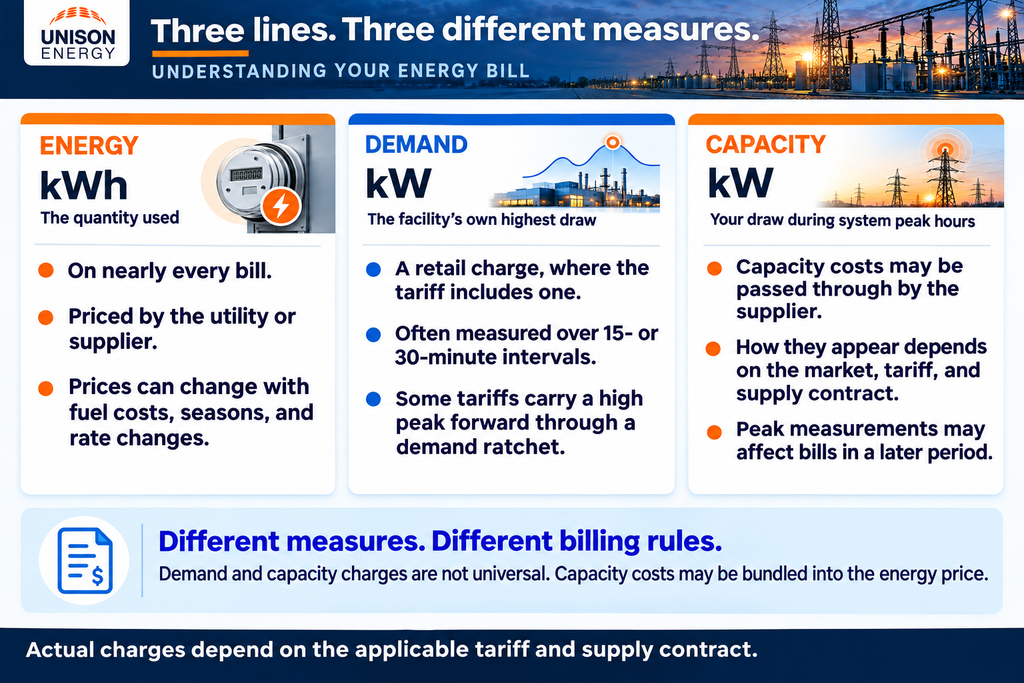
Three things can change: the energy price, a demand charge, and in some markets a capacity charge.
The energy line (kWh) appears on nearly every bill. The utility or the supplier sets its price, and it can change with fuel, the season, and the next rate. Those changes add up at scale. Take PJM, the grid operator for much of the Mid-Atlantic and Midwest: an 8 MW load running around the clock pays about $700,000 more each year for every one cent per kWh increase.1,2
The energy line is only the starting point, though. A demand charge (kW) can appear on top of it. A demand charge (kW) can appear on top of it. Where the rate includes one, it follows the facility’s highest draw. On some rates, that draw ratchets: one high interval (often 15 or 30 minutes) can set a minimum that stays on the bill for months afterward. It is a retail charge, and it is not limited to one part of the country.
A capacity charge (kW) is a separate charge. It is based on the kilowatts recorded during the system’s peak hours, and the supplier passes that cost through. It is billed in four wholesale markets: PJM Interconnection, ISO New England, the New York ISO, and the Midcontinent ISO. The Southwest Power Pool, ERCOT, the California ISO, and the Southeast outside those markets do not bill a separate capacity charge.
Generation online during those hours can reduce the recorded kilowatts. In these markets, those kilowatts are often recorded in one season and then applied to the monthly bills of a later period, so a charge on this month’s bill can reflect kilowatts measured months earlier. In PJM Interconnection, the kilowatts are measured in one summer and then used, unchanged, on each monthly bill of the next delivery year.3 For an illustrative 8 MW load in PJM, the annual capacity charge rose from about $84,000 to about $960,000 in two years—an increase of more than 1,000%.1,2
That is why some facilities install onsite generation and run it when a peak is expected. Combined heat and power (CHP), also called cogeneration, is one example, and it can also supply useful heat from the same fuel. If the unit produces during the hour that matters, it can reduce the electricity draw that sets the charge. The same decision makes the facility the operator, the fuel buyer, and the party that maintains the asset. Fuel has its own price, and maintenance and repair costs can vary. The relevant peak periods are determined by the tariff and system conditions. Dispatching against them is a reaction to a market the facility does not control.
Can onsite generation make energy costs more predictable?
Onsite generation can be a contracted purchase, designed to run throughout the operating day. The goal is to lower purchased energy costs. Electricity from the system can reduce the kilowatt-hours the facility buys from the utility. When the facility also needs heat, CHP can supply it from the same fuel and reduce the fuel that would otherwise be burned separately.
How much a facility’s energy costs change depends on the price in the Energy Services Agreement, the tariff, the system’s configuration, and whether it is running when those charges are set. The system works alongside the grid, and a CHP-based microgrid designed for island operation can keep selected loads running during a grid outage.
Under a Energy-as-a-Service model, Unison Energy finances, designs, builds, owns, operates, and maintains the onsite system. Under an Energy Services Agreement, the facility pays for electricity and, where the system produces it, for thermal energy, without making the upfront capital investment or assuming day-to-day operating responsibility. Because the price is set in the agreement, the facility can plan around it. That can make the cost of purchased energy more visible and reduce exposure to utility rate increases.
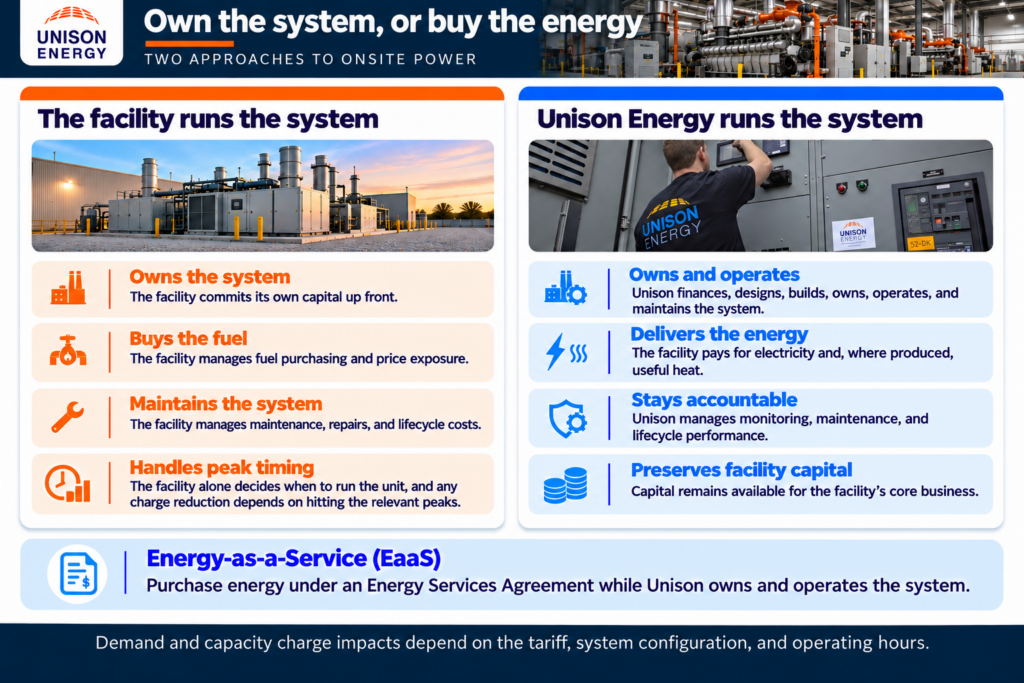
A typical agreement runs 15 to 20 years, and Unison stays accountable for the system the whole way. Because Unison earns revenue when the system produces and delivers energy, its incentives line up with the facility’s: uptime, steady performance, and a plant that is maintained for the long haul. Monitoring, maintenance, overhauls, and replacements are Unison’s job, and the capital that would have gone into a power plant stays available for the facility’s core business.
How can you find out if onsite power fits your facility?
You cannot control the grid. But you can take greater control of your power.
See whether onsite power could be a fit for your facility. Contact Unison Energy to request a complimentary, no-obligation energy assessment, and we will review your facility’s energy bills to see whether it could lower your purchased energy costs.
Sources
1. PJM Interconnection. “PJM Capacity Auction Procures Adequate Resources.” insidelines.pjm.com (2024/2025 delivery year).
2. PJM Interconnection. “PJM Auction Procures 134,311 MW of Generation Resources; Supply Responds to Price Signal.” insidelines.pjm.com (2026/2027 delivery year).
3. PJM Interconnection. “FAQs for 5CPs and Peak Shaving.” pjm.com, 2016.
4. U.S. Energy Information Administration. “Prices and factors affecting prices.” eia.gov.
5. National Laboratory of the Rockies. “The Evolving Role of Demand Charges in Retail Electricity Rates.” Technical report NLR/TP-7A40-90964, March 2026.
6. Pacific Northwest National Laboratory. “What is a demand ratchet?” feds.pnnl.gov.
7. U.S. Environmental Protection Agency. “What is CHP?” epa.gov.

ByUnison Energy
Share on
Share on
About us
Engineered for Performance. Built for the Long Term.
Unison Energy combines capital strength, technical expertise, and operational discipline to deliver resilient power for facilities across industries.
Related posts
Insights shaped by over a decade of experience
Explore more perspectives on energy costs, resilience, and on-site generation from the Unison Energy team.
View All Blogs