Can Your Resort’s Backup Power Keep Events Running?
Blog
Hospitality
Key Takeaways:
- A resort’s standby generator typically covers essential safety systems but not the kitchen, ballroom cooling, and other loads an event depends on.
- Onsite power runs every day, and combined heat and power (CHP), also called cogeneration, captures heat from the same fuel to supply hot water.
- Onsite power can also lower peak-related electricity costs and add capacity for growth, depending on the site and utility tariff.
- With Energy-as-a-Service (EaaS), Unison Energy owns and runs the system for 15 to 20 years, and the resort keeps its capital.
U.S. hotels hosted 129 million group room nights through June 2026, up 2.4% from a year earlier, according to CoStar.1 Those groups bring the weddings, conferences, and banquets that fill a ballroom on a Saturday night. At a resort or hotel, lodging, dining, and events all come together under one roof. There’s a wedding dinner on the books, a ballroom that’s been promised to a client, and a few hundred guests who expect the air to be cool and the shower to be hot.
What goes first when the power fails?
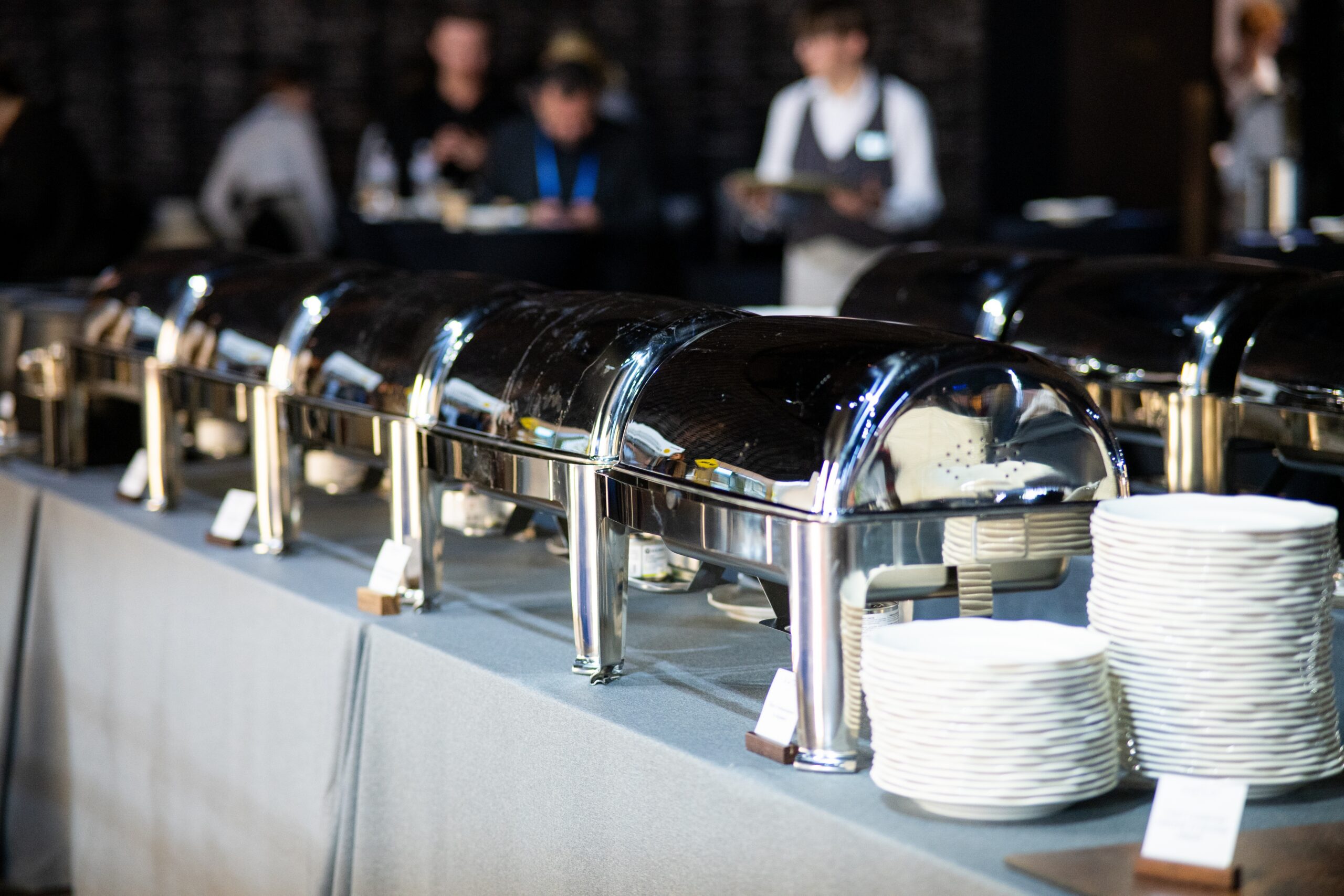
Dinner usually goes first, because it runs on a clock. Appetizers, the main course, and the after-dinner program all need the kitchen and the ballroom for the whole evening. If the utility drops partway through, and the backup system does not serve the kitchen and ballroom equipment, service stops. Half-prepared food often must be thrown out. And you can’t reschedule a wedding for guests who flew in for it. Upstairs, the air conditioning shuts off, and hot water stops reaching the rooms if the pumps and controls lose power.
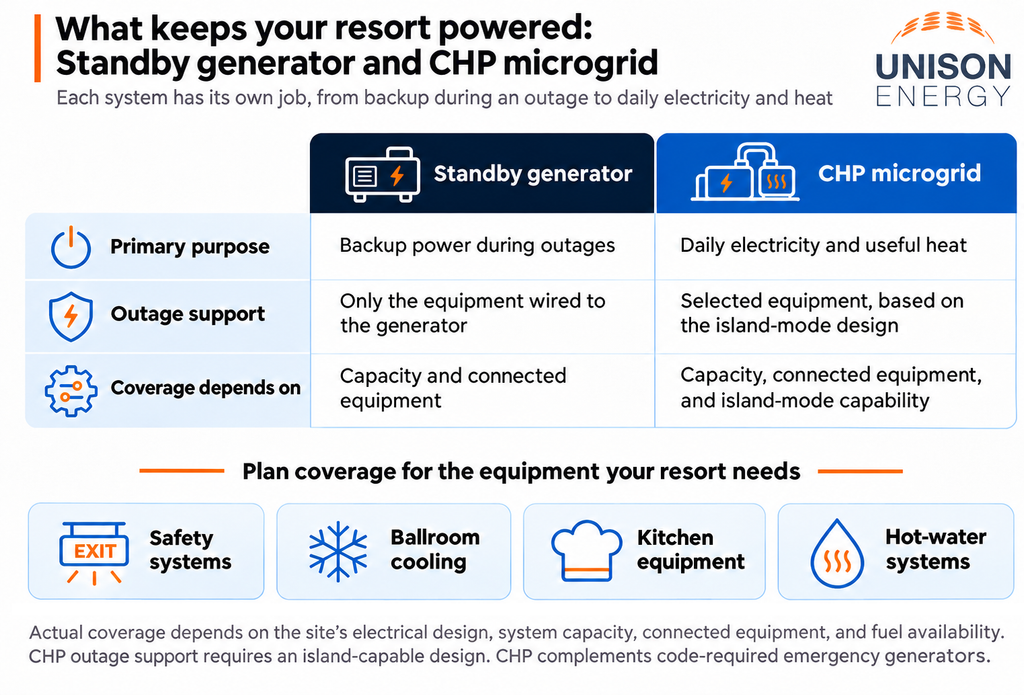
A standby generator powers only the equipment wired to it, typically essential safety systems and a few selected resort operations. Emergency engines are usually limited to 100 hours of maintenance and testing per year while utility power is available. Running during an actual outage doesn’t count against that limit, though a permit may set tighter rules.2 If ballroom air handlers, kitchen equipment, or hot-water pumps and controls are outside the generator’s designated loads, they lose power when the utility goes out.
Can onsite power run a resort or hotel at full occupancy?
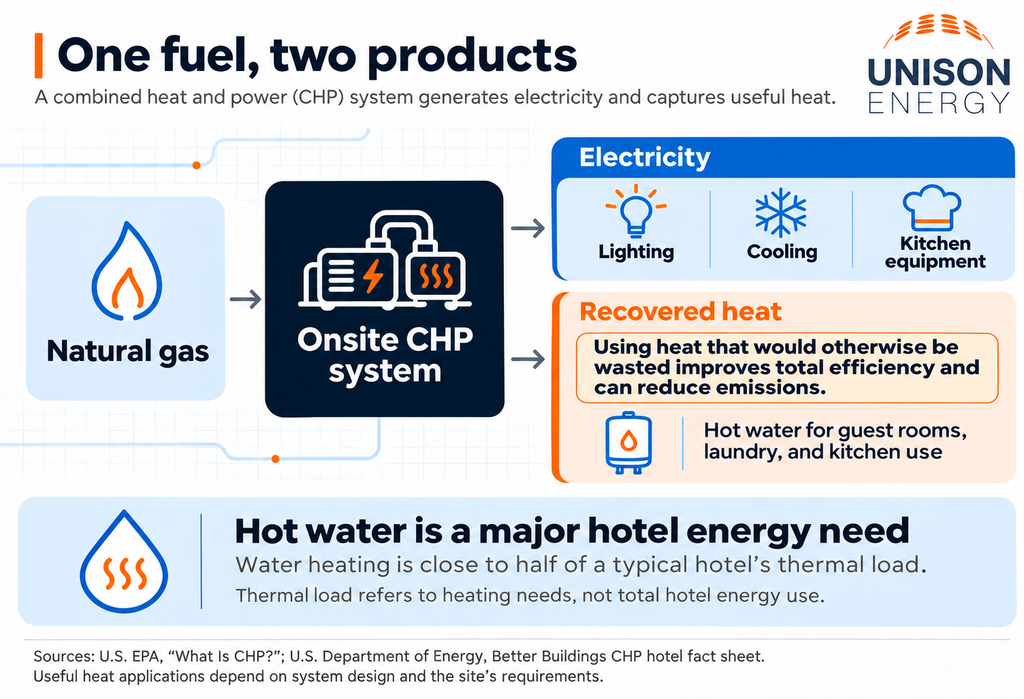
Yes. Onsite power, also called onsite generation, can run a resort or hotel at full occupancy when it is sized for the property’s load. When designed for island mode, a CHP microgrid keeps selected equipment powered during an outage. It complements the resort’s code-required emergency generators rather than replacing them. A combined heat and power (CHP) system, also called cogeneration, captures heat from generating electricity and uses it to supply hot water for guest rooms, laundry, and kitchen use. Putting that heat to use improves total efficiency and can reduce emissions.
Hot water matters more than most people think. According to the Department of Energy, water heating is close to half of a typical hotel’s thermal load.4 In a resort with guest rooms, a laundry, and a banquet kitchen, that demand doesn’t stop when the last plate goes out. The dish line and the laundry keep running well into the night.
How does onsite power affect a resort’s energy costs?
Utility costs are one of the fastest-growing expenses for hotels, up 28% from 2019 to 2025, according to the American Hotel & Lodging Association.5 The electricity the CHP system produces reduces what the resort buys from the utility, while recovered heat can reduce the fuel needed to supply hot water for guest rooms, laundry, and kitchen use. Whether the total bill goes down depends on the Energy Services Agreement, the utility tariff, and how many hours the system runs.
Onsite power can also reduce peak-related electricity costs by lowering the resort’s demand on the grid during the hours used to calculate those charges. In some markets, such as PJM, a customer’s electricity use during designated summer peak hours can influence its capacity-related costs.⁶ Generating onsite during those hours reduces that exposure. The benefit depends on the applicable utility tariff, electricity supply contract, and system operation.
Growth is another reason to look at onsite power. A new ballroom or a rebuilt kitchen may need more power than the utility can deliver on your schedule. If the site has room for the equipment and a fuel supply, the permits come through, and the load is big enough, onsite power can add capacity on your side of the meter instead of waiting on utility upgrades.
What does Energy-as-a-Service mean for a resort?
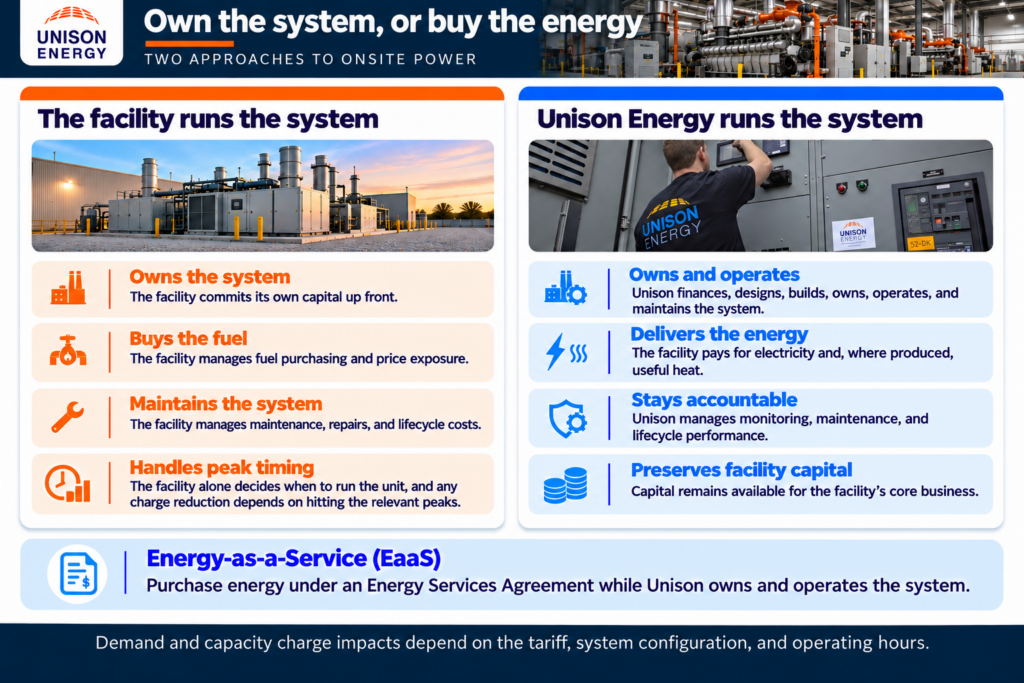
Under Energy-as-a-Service, Unison Energy finances, designs, builds, owns, operates, and maintains the system. The resort signs an Energy Services Agreement and pays for the electricity and, if the system supplies it, for heat. Agreements usually run 15 to 20 years. For that term, Unison handles monitoring, maintenance, major overhauls, and equipment replacement, and stays accountable for how the system performs.
The money the resort would have spent on a power plant stays available for guest rooms, a new venue, or anything else on the property.
Is onsite power a fit for your resort or hotel?
You can’t control the grid. But you can take greater control of how your resort is powered.
Find out what your resort’s backup power covers before the next sold-out Saturday. Request a free, no-obligation energy assessment, and our team will review your electric and thermal loads and tell you whether onsite power could lower your energy costs and keep your events running.
Sources
- CoStar (via Hotel Online). “20 Stats Every Hotel Group Sales Team Should Know to Prepare for 2027.” hotel-online.com (September 24, 2026).
- Electronic Code of Federal Regulations. “40 CFR 63.6640(f).” ecfr.gov.
- U.S. Environmental Protection Agency. “What is CHP?” epa.gov.
- U.S. Department of Energy, Better Buildings. “CHP Market Sector Fact Sheet: Hotels.” betterbuildingssolutioncenter.energy.gov.
- American Hotel & Lodging Association. “2026 State of the Industry.” ahla.com.
- PJM Interconnection. “PJM Manual 19: Load Forecasting and Analysis.” pjm.com (Revision 39, effective June 30, 2026).
- Federal Energy Regulatory Commission. “Understanding Wholesale Capacity Markets.” ferc.gov; PJM Interconnection. “Capacity Market (RPM).” pjm.com.
ByUnison Energy
Share on
Share on
About us
Engineered for Performance. Built for the Long Term.
Unison Energy combines capital strength, technical expertise, and operational discipline to deliver resilient power for facilities across industries.
Related posts
Insights shaped by over a decade of experience
Explore more perspectives on energy costs, resilience, and on-site generation from the Unison Energy team.
View All Blogs